Semaglutide Dosing Guide: Vial Sizes, Weekly Doses, Titration & How to Measure Your Dose
Understand your semaglutide dose in mg, mL, and syringe units. See the example titration chart, vial sizes, missed-dose guidance, and key safety tips.
Read MoreA practical guide to tirzepatide dosing, vial sizes, weekly dose escalation, syringe-unit conversions, and safe administration of compounded tirzepatide.


Medically Reviewed by:
Dr. Jonathan C. Miller, MD | Dr. Benjamin Krasne, MD
This guide is for educational purposes only and applies only to the 10 mg/mL compounded Tirzepatide/Glycine/B12 formulation described here. It does not replace advice from your healthcare provider. Always follow the dose and instructions provided with your prescription. Read the full medical disclaimer
Before starting tirzepatide from a multi-dose vial, it is important to understand a few basic measurements. Your prescription may include mg, mL, and syringe units, and knowing how these measurements relate to each other can help you understand how much medication to draw for your prescribed dose.
Compounded tirzepatide may be supplied in a multi-dose vial containing a specific volume of medication, while your prescription tells you how much to use for each weekly injection.
For the Tirzepatide/Glycine/B12 formulation described in this guide, the pharmacy provides a sample dose-escalation framework that gradually increases the weekly tirzepatide dose.
Remember: Your vial size is not your weekly dose. Your prescribed dose is determined and adjusted by your healthcare provider.
Tirzepatide is a medication that activates two hormone receptors involved in blood glucose regulation and appetite: the glucose-dependent insulinotropic polypeptide (GIP) receptor and the glucagon-like peptide-1 (GLP-1) receptor.
These pathways are involved in several processes related to hunger, food intake, digestion, and glucose regulation.
Tirzepatide can influence appetite and food intake, which may help some people consume fewer calories as part of a comprehensive weight-management plan.
It also affects blood glucose regulation and slows gastric emptying.
Because tirzepatide remains in the body for an extended period, injectable treatment is administered once weekly. Read how tirzepatide works for weight loss
The main reason is tolerability.
Tirzepatide can cause gastrointestinal side effects, particularly when treatment begins or the dose is increased. These may include nausea, vomiting, diarrhea, constipation, abdominal discomfort, and reflux.
Gradual dose escalation gives your body time to adjust to treatment.
Your healthcare provider may therefore keep you at a dose longer, delay an increase, or modify your treatment plan if side effects become difficult to manage.
The formulation described in this guide contains:
In other words, every 1 mL of this formulation contains:
Because this formulation contains 10 mg of tirzepatide per mL, the volume you withdraw determines how many milligrams of tirzepatide you receive.
For example:
0.2 mL × 10 mg/mL = 2 mg tirzepatide
This relationship is important when reading your prescription.
The following is the sample dose-escalation framework provided for the specific Tirzepatide/Glycine/B12 10 mg/5 mg/500 mcg/mL formulation.
| Treatment Period | Prescription | Tirzepatide Dose | Injection Volume | Syringe Units | Frequency |
|---|---|---|---|---|---|
| Weeks 1–4 | RX #1 | 2 mg | 0.2 mL | 20 units | Once weekly |
| Weeks 5–8 | RX #2 | 4 mg | 0.4 mL | 40 units | Once weekly |
| Weeks 9–12 | RX #3 | 7 mg | 0.7 mL | 70 units | Once weekly |
| Weeks 13–16 | RX #4 | 9 mg | 0.9 mL | 90 units | Once weekly |
| Weeks 17–20 | RX #5 | 12 mg | 1.2 mL | 120 units | Once weekly |
| Week 21 onward | RX #6 | 14 mg | 1.4 mL | 140 units | Once weekly |
Important: This is a sample prescribing framework for the specific compounded concentration described above. It is not a universal tirzepatide dosing schedule. Your healthcare provider determines your actual dose and may change the timing or amount of dose increases based on your individual response and tolerability.
This is one of the most common sources of confusion with compounded injectable medications.
Your tirzepatide may be supplied in a vial containing:
1 mL, 2 mL, 3 mL, or 4 mL.
This number tells you the total volume of liquid in the vial.
It does not tell you how much to inject at one time.
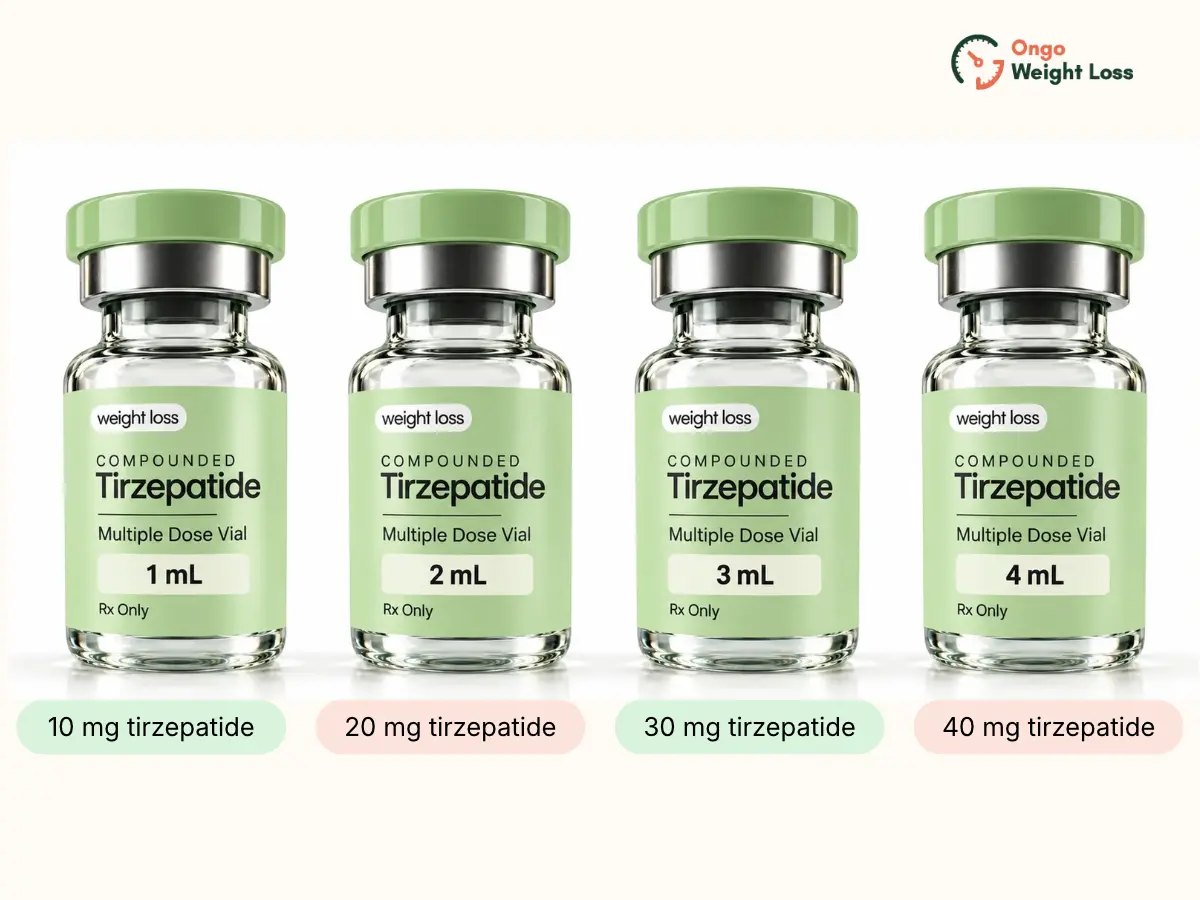
For the formulation described in this guide:
| Vial Size | Total Tirzepatide in Vial |
|---|---|
| 1 mL | 10 mg |
| 2 mL | 20 mg |
| 3 mL | 30 mg |
| 4 mL | 40 mg |
For example, a 2 mL vial contains 20 mg of tirzepatide in total. It does not mean that you should inject 2 mL at once.
Your prescription tells you how much to withdraw for each weekly injection.
That depends on your prescribed weekly dose.
Because your dose may change during titration, the same vial size can provide a different number of injections depending on your prescribed dose.
For example, a 1 mL vial contains 1 mL of medication.
If your prescribed dose requires 0.2 mL per week:
1 mL ÷ 0.2 mL = 5 weekly doses by volume
However, this does not mean you should automatically use a vial for five injections.
The actual usable period depends on your prescription, pharmacy instructions, storage requirements, vial handling instructions, and beyond-use date.
Do not continue using a vial simply because medication remains inside it. Follow the instructions provided by your dispensing pharmacy.
When you receive your tirzepatide vial, several numbers may appear on the label or prescription.
They describe different things.
| What You're Looking At | What It Tells You | Example for This Formulation |
|---|---|---|
| Vial size | Total amount of liquid supplied | 1 mL, 2 mL, 3 mL, or 4 mL |
| Concentration | Amount of tirzepatide in each mL | 10 mg/mL |
| Prescribed dose | Amount of tirzepatide your provider wants you to receive | 2–14 mg |
| Injection volume | Amount of liquid withdrawn from the vial | 0.2–1.4 mL |
| Syringe units | Syringe marking used to measure the prescribed volume | 20–140 units |
Keeping these measurements separate makes your prescription easier to understand.
For the 10 mg/mL formulation described here:
2 mg tirzepatide → 0.2 mL → 20 syringe units
As the prescribed dose increases, the corresponding injection volume and syringe measurement increase.
| Tirzepatide Dose | Injection Volume | U-100 Syringe Units* |
|---|---|---|
| 2 mg | 0.2 mL | 20 units |
| 4 mg | 0.4 mL | 40 units |
| 7 mg | 0.7 mL | 70 units |
| 9 mg | 0.9 mL | 90 units |
| 12 mg | 1.2 mL | 120 units |
| 14 mg | 1.4 mL | 140 units |
*These measurements correspond to the 10 mg/mL concentration described in this guide and a U-100 syringe. A different tirzepatide concentration would require different volume and unit calculations. Doses requiring more than 100 units may require a different syringe size or administration instructions. Follow the syringe and injection instructions supplied by your pharmacy.
This is the starting stage in the supplied framework.
The lower starting dose gives your body an opportunity to adjust to tirzepatide.
You may begin noticing changes in hunger, fullness, appetite, or food intake, but your response can vary.
The first several weeks are also about assessing tolerability.
The sample framework then increases to 4 mg once weekly.
Your provider can evaluate how you responded to the starting dose before deciding whether an increase is appropriate.
If you are experiencing significant side effects, your provider may recommend remaining at the current dose longer or modifying the titration schedule.
The next stage in the supplied framework is 7 mg once weekly.
At this point, your provider may consider your treatment response, appetite changes, side effects, weight-management progress, lifestyle factors, and other health considerations.
The sample framework then increases to 9 mg once weekly.
This is not an instruction to increase your dose independently.
Your healthcare provider determines whether moving to the next stage is appropriate for you.
The next stage is 12 mg once weekly.
Your provider may continue titration if the treatment is well tolerated and additional medication is clinically appropriate.
If you are doing well at a lower dose, your provider may determine that an increase is not necessary.
The supplied framework lists 14 mg once weekly as the next stage after week 20.
Reaching this stage does not mean every patient needs to remain at 14 mg.
Your provider may determine that a lower dose provides an appropriate balance between treatment response and tolerability.
You may not necessarily need to increase your dose simply because you have reached the next scheduled period.
Your pharmacy's framework recommends using variable dosing to achieve the lowest beneficial dose, even when that differs from the example schedule.
The purpose of titration is not to reach the highest possible dose as quickly as possible.
It is to find a dose that provides an appropriate response while remaining tolerable.
If you are doing well at your current dose, discuss your response with your healthcare provider before making any change.
Proper storage is important for maintaining the quality of your compounded medication.
Because compounded tirzepatide may be prepared by different pharmacies and formulations can have different storage requirements, follow the storage instructions provided by your dispensing pharmacy and prescription label.
Keep These Storage Basics in Mind
A multi-dose vial may have specific instructions for how long it can be used after the first puncture.
Do not assume that the vial remains usable until all medication has been withdrawn.
Your pharmacy's instructions should tell you:
Important: A larger vial does not automatically mean that it should be used for a longer period.
Follow the pharmacy's beyond-use date and handling instructions even when medication remains in the vial.
Some people experience gastrointestinal side effects when starting tirzepatide or increasing the dose.
Possible side effects include:
If your symptoms become difficult to manage, do not increase your dose on your own.
Contact your prescribing provider.
Your provider may decide to:
This can happen, particularly during the early stages of treatment.
The initial dose is intended to allow your body to adjust, and individual responses vary.
Do not respond by drawing additional medication from your vial.
Instead, speak with your healthcare provider.
Your provider can determine whether:
Never use additional syringe units simply because you feel the medication is not working yet.
You should not change your prescribed dose or accelerate your titration schedule without speaking with your healthcare provider.
Increasing too quickly may make gastrointestinal side effects more difficult to tolerate.
Your treatment schedule may therefore look different from someone else's.
That is expected.
Your dose should be individualized according to your response and tolerability.
The formulation described in this guide is administered:
Once weekly by subcutaneous injection.
Try to follow the same weekly schedule prescribed by your provider.
Do not take additional doses because you believe a previous dose was not strong enough.
Tirzepatide is administered as a subcutaneous injection, meaning it is injected into the tissue beneath the skin.
Follow the injection-site and administration instructions supplied with your prescription.
If you have never used a medication vial and syringe before, ask your healthcare provider or pharmacist to demonstrate the injection technique.
Do not attempt to estimate the dose or improvise syringe measurements.
Do not automatically double your next dose.
Because missed-dose instructions can depend on the specific product and prescribing instructions, follow the directions supplied with your medication.
If you are unsure what to do after missing a dose, contact your prescribing provider or pharmacy.
Do not take an extra injection to make up for a missed dose unless your provider specifically instructs you to do so.
Missing several weekly injections is different from being slightly late.
Do not automatically restart at the same dose you were taking before the interruption.
Tell your healthcare provider how long it has been since your last injection.
Depending on the length of the interruption and your previous dose, your provider may determine that you should restart at a lower dose or repeat part of the titration process.
If you accidentally inject more tirzepatide than prescribed, contact your healthcare provider promptly.
Too much medication may increase the risk or severity of side effects, particularly gastrointestinal symptoms.
Seek urgent medical attention if you develop severe or concerning symptoms.
Do not take another dose until you have received appropriate instructions from your healthcare provider.
Imagine your prescription says:
Inject 40 units once weekly.
You might assume that 40 units always represents the same amount of tirzepatide.
It does not.
The actual medication dose depends on the concentration of your vial.
For the formulation described in this guide:
10 mg tirzepatide = 1 mL
Therefore:
40 units = 0.4 mL = 4 mg tirzepatide
But a different compounded formulation may have a different concentration.
That means the same number of syringe units could deliver a different amount of tirzepatide.
Your safest rule is:
Use the dose, volume, and syringe-unit instructions provided with your specific prescription.
Do not copy a conversion from another vial.
This depends on:
For the formulation described here:
| Vial Size | Total Liquid | Tirzepatide Concentration | Total Tirzepatide |
|---|---|---|---|
| 1 mL | 1 mL | 10 mg/mL | 10 mg |
| 2 mL | 2 mL | 10 mg/mL | 20 mg |
| 3 mL | 3 mL | 10 mg/mL | 30 mg |
| 4 mL | 4 mL | 10 mg/mL | 40 mg |
This does not mean you should use a vial for a predetermined number of weeks.
Your prescribed dose can change during titration, and the pharmacy determines the appropriate dispensing quantity, storage requirements, and beyond-use date.
Use the vial only according to your prescription and pharmacy instructions.
Your vial size may change as your weekly injection volume increases.
For the sample framework:
The important point is:
A larger vial does not mean a larger single dose.
It simply means that more total medication has been supplied.
This distinction matters.
A dosing schedule for an FDA-approved tirzepatide product should not automatically be applied to a compounded Tirzepatide/Glycine/B12 formulation.
Different products may have different concentrations, formulations, prescribing instructions, and dosing schedules.
The sample framework in this guide is specifically based on the 10 mg/mL compounded formulation described above.
Therefore:
Do not take a dosing chart for another tirzepatide product and use it to calculate the dose from your compounded vial.
Always use the instructions supplied with your specific prescription.
No.
A higher dose is not automatically the right dose for every patient.
Increasing the dose can also increase the likelihood or severity of adverse effects.
Your provider may decide to keep you at a lower dose when it provides an appropriate treatment response and is better tolerated.
The goal is to find the dose that works appropriately for you, rather than simply reaching the highest number in a dosing chart.
Your provider may consider several factors rather than relying on the scale alone.
Your provider can use this information to determine whether your current dose should be maintained, adjusted, or increased.
Tirzepatide is not for everyone. Tell your provider about your medical history and all medications you take.
Tirzepatide may reduce hunger and food intake, but it does not replace a balanced nutrition plan.
Focus on:
Smaller meals may be easier to tolerate, especially during dose increases. If you experience gastrointestinal symptoms, discuss your nutrition and hydration with your healthcare provider.
Weight loss can involve both fat and lean tissue. A comprehensive plan may include:
The glycine in this compounded formulation does not guarantee prevention of muscle loss. Discuss your nutrition and exercise plan with your healthcare provider or a qualified nutrition professional.
Tirzepatide is not recommended for weight loss during pregnancy. Weight loss offers no benefit during pregnancy and may pose risks to the developing baby. Animal studies have shown potential reproductive risks, although the effects of tirzepatide in human pregnancy are not fully established.
The safety of this compounded tirzepatide formulation during pregnancy and breastfeeding has not been established.
If You Are Pregnant
Do not use tirzepatide for weight loss during pregnancy. If you become pregnant while taking tirzepatide, stop the medication and contact your healthcare provider promptly.
If You Are Planning to Become Pregnant
Tell your healthcare provider before you start treatment or as soon as you begin planning a pregnancy. Because tirzepatide stays in the body for an extended period, your provider can advise you on when to stop treatment before trying to conceive.
If You Are Breastfeeding
Talk to your healthcare provider before using tirzepatide. The safety of tirzepatide during breastfeeding has not been fully established.
Tirzepatide and Birth Control Pills
Tirzepatide may make birth control pills and other oral hormonal contraceptives less effective. This is because tirzepatide slows stomach emptying, which can affect how well oral medications are absorbed.
FDA-approved tirzepatide labeling advises people who use oral hormonal contraceptives to switch to a non-oral method, or add a barrier method such as condoms, for 4 weeks after starting treatment and for 4 weeks after each dose increase.
If you use birth control pills, tell your healthcare provider before starting tirzepatide. Your provider can recommend the right contraception plan for you.
What If You Become Pregnant While Taking Tirzepatide?
Stop taking tirzepatide and contact your healthcare provider promptly. Let your healthcare team know when you took your last dose and how much you received. Do not restart treatment during pregnancy unless your healthcare provider specifically advises you to.
Tirzepatide should not be combined with another GLP-1 receptor agonist or another medication containing tirzepatide unless specifically directed by your healthcare provider.
If you are switching from another GLP-1 medication, tell your provider.
Your provider can determine the appropriate transition plan.
Do not overlap medications simply because they are both used for weight management.
If you use insulin or certain other medications that lower blood glucose, your provider may need to consider your complete medication regimen.
Tell your provider about every prescription medication, over-the-counter medication, vitamin, and supplement you take.
Do not change your other diabetes medications on your own.
What is the starting dose in this formulation?
The supplied sample framework starts at 2 mg once weekly, corresponding to 0.2 mL or 20 units for the 10 mg/mL formulation and U-100 syringe described in this guide.
How long do I stay at the starting dose?
The sample framework uses the starting dose for 4 weeks.
Your provider may change the duration depending on your response and tolerability.
Does everyone increase the dose every four weeks?
Not necessarily.
The schedule is a sample framework. Your provider may delay, modify, or stop dose increases when clinically appropriate.
What if I feel good at my current dose?
Tell your provider.
You may not need to increase your dose simply because you have reached the next stage of the sample schedule.
What if I don't feel the medication working?
Do not take additional medication.
Talk with your provider about your response and whether your treatment plan needs to be adjusted.
What if I have nausea?
Mild gastrointestinal symptoms can occur, particularly during dose escalation.
If symptoms are significant, persistent, or worsening, contact your healthcare provider. Your provider may delay escalation or modify your dose.
How many doses are in my vial?
That depends on the vial size and your prescribed weekly injection volume.
Your pharmacy's dispensing instructions and beyond-use date also matter.
Can I use the entire vial?
No.
The vial size is not your dose.
Use only the amount prescribed for each injection.
Is 20 units always the same amount of tirzepatide?
No.
The amount of medication represented by syringe units depends on the concentration of the formulation and the syringe being used.
Can I use a dosing chart I found online?
Not unless it specifically matches your exact medication concentration, syringe, and prescription instructions.
Different compounded formulations may use different concentrations.
Can I increase the dose myself?
No.
Dose changes should be made by your prescribing healthcare provider.
What if I accidentally take too much?
Contact your healthcare provider promptly.
If you develop severe or concerning symptoms, seek urgent medical attention.
What if I miss several doses?
Contact your provider before restarting, particularly if you have been off treatment long enough that your previous dose may no longer be appropriate.
The information on this page is provided for educational purposes only and is not intended to replace medical advice, diagnosis, or treatment from a qualified healthcare professional.
Dosing information, titration schedules, syringe measurements, and examples on this page apply only to the specific compounded Tirzepatide/Glycine/B12 formulation described and should not be used to determine or change your personal dose. Compounded medications are not FDA-approved and have not been evaluated by the FDA for safety or efficacy.
Always follow the prescription and instructions provided by your licensed healthcare provider and dispensing pharmacy. Do not change your dose, stop treatment, or combine medications without consulting your provider.
If you experience severe or concerning symptoms, seek immediate medical attention. Contact your healthcare provider if you are pregnant, planning to become pregnant, breastfeeding, or have questions about whether this medication is appropriate for you.
This information does not establish a patient-provider relationship and is not a substitute for individualized medical care.
Jastreboff AM, Aronne LJ, Ahmad NN, et al. Tirzepatide Once Weekly for the Treatment of Obesity. New England Journal of Medicine. 2022;387(3):205–216. doi:10.1056/NEJMoa2206038. New England Journal of Medicine
Read on NEJMGarvey WT, Frias JP, Jastreboff AM, et al. Tirzepatide Once Weekly for the Treatment of Obesity in People With Type 2 Diabetes (SURMOUNT-2). The Lancet. 2023;402(10402):613–626. doi:10.1016/S0140-6736(23)01200-X. PubMed
Read on PubMedU.S. Food and Drug Administration. FDA's Concerns With Unapproved GLP-1 Drugs Used for Weight Loss. This is particularly relevant to your page's discussion of compounded tirzepatide and dosing errors. U.S. Food and Drug Administration
Read on FDA.govRamos-Jiménez A, Hernández-Torres RP, Hernández-Ontiveros DA, et al. An Update of the Promise of Glycine Supplementation for Enhancing Physical Performance and Recovery. Sports (Basel). 2024;12(10):265. doi:10.3390/sports12100265. PubMed Central (PMC)
Read the full article on PMCAnkar A, Kumar A. Vitamin B12 Deficiency. StatPearls. Updated September 10, 2024.
Read on NCBI BookshelfFarzam K, Patel P. Tirzepatide. StatPearls. Updated February 20, 2024.
Read on NCBI Bookshelf
Understand your semaglutide dose in mg, mL, and syringe units. See the example titration chart, vial sizes, missed-dose guidance, and key safety tips.
Read More
Read mechanism of semaglutide for weight loss, the dosing schedule, clinical trial results, side effects, costs, and what happens when you stop treatment.
Read More
Nearly 49.1% of U.S. adults struggle to lose weight. Learn what GLP-1 medications are, who is eligible, and how they support sustainable weight loss.
Read More