Tirzepatide Dosing Guide: Vial Sizes, Weekly Doses, Titration & How to Measure Your Dose
Understand your tirzepatide dose in mg, mL, and syringe units. See the example titration chart, vial sizes, missed-dose guidance, and key safety tips.
Read MoreA practical guide to semaglutide dosing, vial sizes, syringe-unit conversions, dose escalation, and safe administration of compounded semaglutide.


Medically Reviewed by:
Dr. Jonathan C. Miller, MD | Dr. Benjamin Krasne, MD
This guide is for educational purposes only and applies only to the 5 mg/mL compounded semaglutide formulation described here. It does not replace advice from your healthcare provider. Always follow the dose and instructions provided with your prescription. Read the full medical disclaimer
Starting semaglutide can feel confusing at first.
You may see several different numbers on your prescription or medication vial: mg, mL, and syringe units.
Then there is another question: “If I received a 0.5 mL, 1 mL, or 2 mL vial, how much am I actually supposed to inject?”
These are important questions to get right.
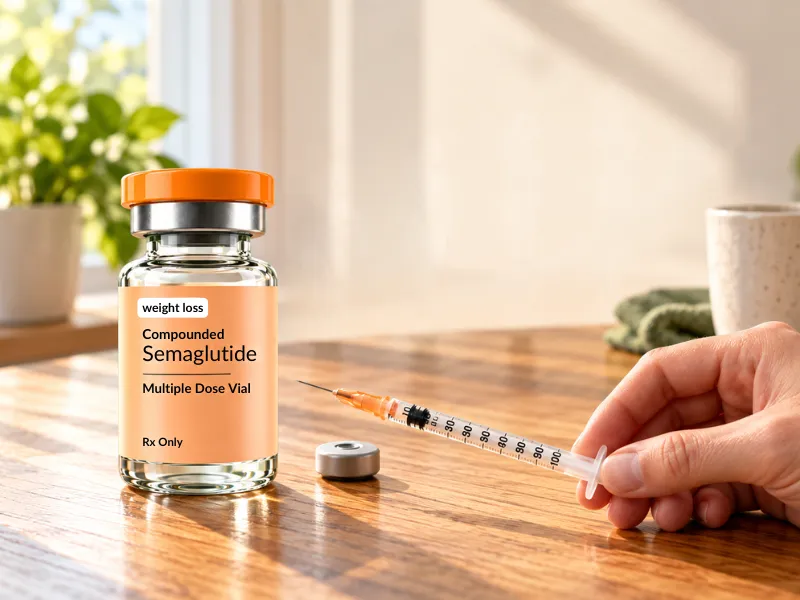
Unlike a prefilled pen that delivers a preset dose, compounded semaglutide may be dispensed in a multi-dose vial. The vial contains a specific total volume of medication, while your prescription tells you how much to use for each weekly injection.
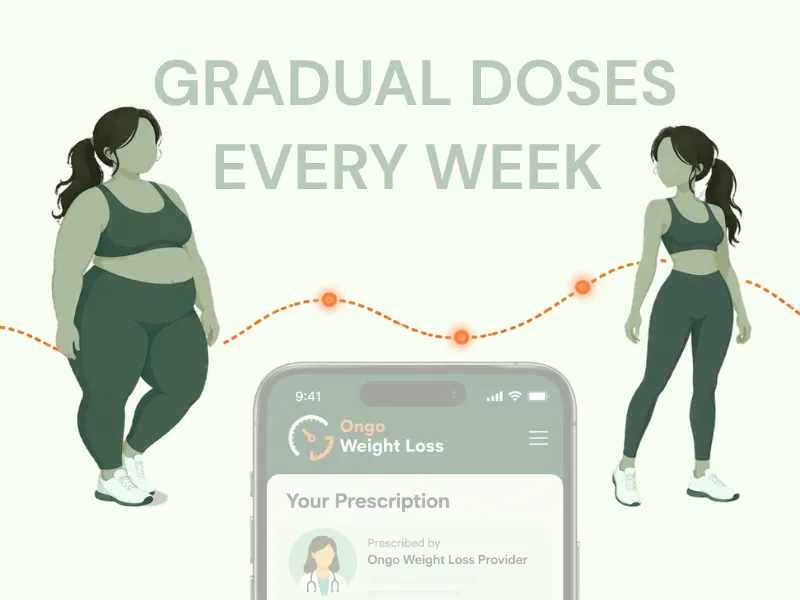
For our Semaglutide formulation, the pharmacy provides a sample dose-escalation framework that gradually increases the semaglutide dose over time.
But the most important thing to remember is this:
The size of your vial is not your weekly dose. Your weekly dose is the amount prescribed by your healthcare provider.
Your provider may also adjust your dose based on your response and tolerability. The pharmacy's prescribing framework specifically allows for variable dosing to help achieve the lowest beneficial dose.
Let's break everything down.
Semaglutide is a GLP-1 receptor agonist, meaning it acts similarly to the naturally occurring hormone glucagon-like peptide-1 (GLP-1).
Your body naturally produces GLP-1, particularly after you eat. It plays a role in several processes involved in blood glucose, digestion, hunger, and appetite.
Semaglutide is structurally modified so that it remains in the body much longer than naturally produced GLP-1. Its elimination half-life is approximately one week, which is one reason injectable semaglutide can be administered once weekly.
So, how does it help with weight management?
GLP-1 receptors are found in areas involved in appetite, food intake, and reward.
When GLP-1 receptor agonists activate these pathways, they can influence hunger, fullness, and food intake. For some people, this can also make cravings and persistent thoughts about food less intense.
Semaglutide also affects glucose regulation and slows gastric emptying.
In other words, semaglutide works across several systems involved in appetite, digestion, and blood glucose regulation, which can make it easier to eat less and maintain a calorie deficit over time. Read full mechanism
You may wonder why semaglutide is not simply started at a higher dose.
The reason is tolerability.
Semaglutide can cause gastrointestinal side effects, particularly when treatment is started or the dose is increased. These may include nausea, vomiting, diarrhea, constipation, abdominal discomfort, and reflux.
That is why semaglutide treatment generally uses gradual dose escalation rather than starting immediately at a higher dose.
Current 2026 American Diabetes Association guidance recommends starting obesity medications that require dose escalation at a low dose and increasing them gradually based on tolerability and clinical response. It also notes that slower titration or smaller dose increases may be appropriate for people experiencing gastrointestinal difficulties.
The goal is to find a dose that provides an appropriate treatment response while remaining tolerable.
The formulation available on our website and discussed in this guide contains:
Semaglutide 5 mg/mL: active medication in the formulation
Glycine 5 mg/mL: An amino acid included in the formulation. Its effect on muscle preservation in people using semaglutide has not been established in clinical studies.
Vitamin B12 1 mg/mL: Included in the formulation. Vitamin B12 is an essential nutrient, but its added benefit in this formulation has not been clinically established.
In other words, every 1 mL of the formulation contains:
Because the formulation has a concentration of 5 mg of semaglutide per mL, the volume injected determines how many milligrams of semaglutide you receive.
For example:
0.04 mL × 5 mg/mL = 0.20 mg semaglutide
That relationship is important when understanding your prescription.
The following is the sample dose-escalation framework provided for this formulation.
| Treatment period | Prescription | Semaglutide dose | Injection volume | Syringe units | Frequency | Required Vial |
|---|---|---|---|---|---|---|
| Weeks 1–4 | RX #1 | 0.20 mg | 0.04 mL | 4 units | Once weekly | 0.5 mL vial |
| Weeks 5–8 | RX #2 | 0.40 mg | 0.08 mL | 8 units | Once weekly | 0.5 mL vial |
| Weeks 9–12 | RX #3 | 0.90 mg | 0.18 mL | 18 units | Once weekly | 1 mL vial |
| Weeks 13–16 | RX #4 | 1.50 mg | 0.30 mL | 30 units | Once weekly | 2 mL vial |
| Week 17 onward | RX #5 | 2.20 mg | 0.44 mL | 44 units | Once weekly | 2 mL vial |
Important: This is a sample prescribing framework. Your healthcare provider determines your actual dose and may modify the timing or amount of dose increases based on your individual response and tolerability.
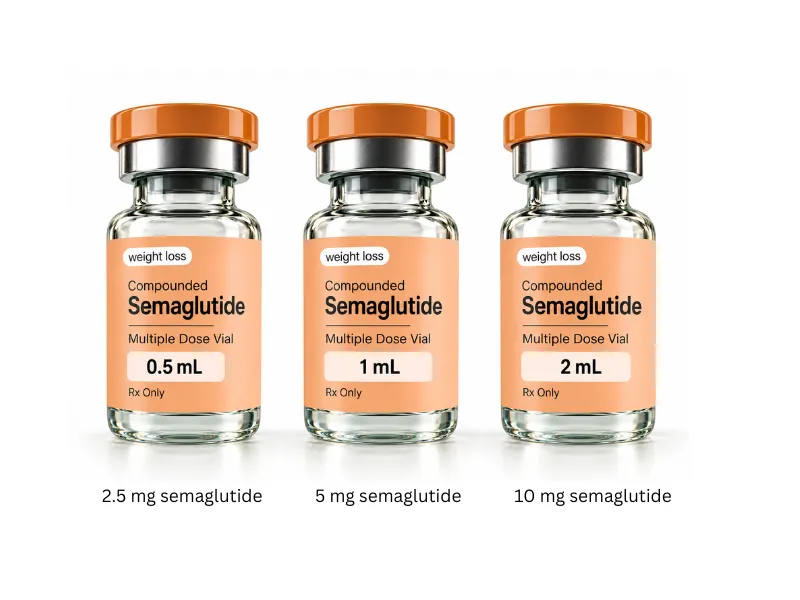
This is where compounded semaglutide can become confusing. Your medication may arrive in a vial containing either: 0.5 mL, 1 mL, or 2 mL.
That number tells you the total volume of liquid contained in the vial.
It does not tell you how much to inject for your weekly dose.
For example, if your vial contains 0.5 mL, that does not mean you should inject 0.5 mL at once.
Your weekly dose may be much smaller.
For the formulation described here:
| 0.5 mL vial contains | 1 mL vial contains | 2 mL vial contains |
|---|---|---|
| 0.5 mL × 5 mg/mL = 2.5 mg semaglutide | 1 mL × 5 mg/mL = 5 mg semaglutide | 2 mL × 5 mg/mL = 10 mg semaglutide |
The vial size simply tells you the total volume supplied.
Your prescription tells you how much to withdraw for each injection.
This depends on the prescribed weekly dose.
Because your treatment dose can increase over time, the same vial size does not necessarily represent the same number of weekly injections for every patient.
For example, a 0.5 mL vial contains 0.5 mL of medication. If the prescribed dose is 0.04 mL per week then:
0.5 mL ÷ 0.04 mL = 12.5 weekly doses by volume
However, that does not mean the vial should automatically be used for 12 or 13 injections.
The actual number of doses you can safely obtain depends on your prescription, the pharmacy's instructions, vial handling requirements, and beyond-use date.
Do not continue using a vial simply because medication appears to remain in it. Follow the storage, handling, and discard instructions provided with your prescription.
When you receive your semaglutide vial, you may see several different numbers on your prescription or dosing instructions. These numbers do not all mean the same thing.
Think of your medication this way:
| What you're looking at | What it tells you | For your formulation |
|---|---|---|
| Vial size | How much liquid is supplied in the vial | 0.5 mL, 1 mL, or 2 mL |
| Concentration | How much semaglutide is contained in each mL | 5 mg/mL |
| Prescribed dose | How much semaglutide your provider wants you to receive | 0.20–2.20 mg |
| Injection volume | How much liquid you withdraw from the vial | 0.04–0.44 mL |
| Syringe units | The marking you use to measure the prescribed volume | 4–44 units |
Units shown assume a U-100 insulin syringe, where 1 unit = 0.01 mL. If your syringe is different, ask your pharmacy how to measure your dose.
For example, if your prescribed dose is 0.20 mg and your medication has a concentration of 5 mg/mL:
0.20 mg semaglutide → 0.04 mL medication → 4 syringe units
As your prescribed dose increases, the injection volume and corresponding syringe units increase as well.
| Semaglutide dose | Injection volume | Syringe units* |
|---|---|---|
| 0.20 mg | 0.04 mL | 4 units |
| 0.40 mg | 0.08 mL | 8 units |
| 0.90 mg | 0.18 mL | 18 units |
| 1.50 mg | 0.30 mL | 30 units |
| 2.20 mg | 0.44 mL | 44 units |
*Units shown here correspond to the 5 mg/mL semaglutide concentration. The meaning of “units” depends on the syringe being used.
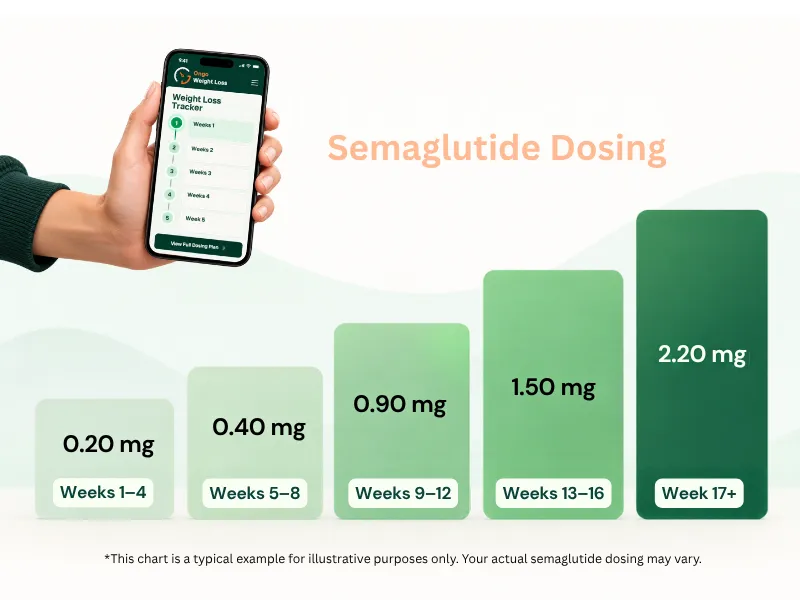
The 2026 ADA Standards specifically state that obesity medication dosing should be individualized to balance effectiveness, health benefits, and tolerability, and that the optimal treatment dose may not be the maximum approved dose.
Proper storage is important to help maintain the quality of your compounded semaglutide.
Because compounded semaglutide may be prepared by different pharmacies and formulations can have different storage requirements, always follow the storage instructions provided by your dispensing pharmacy and on your prescription label.
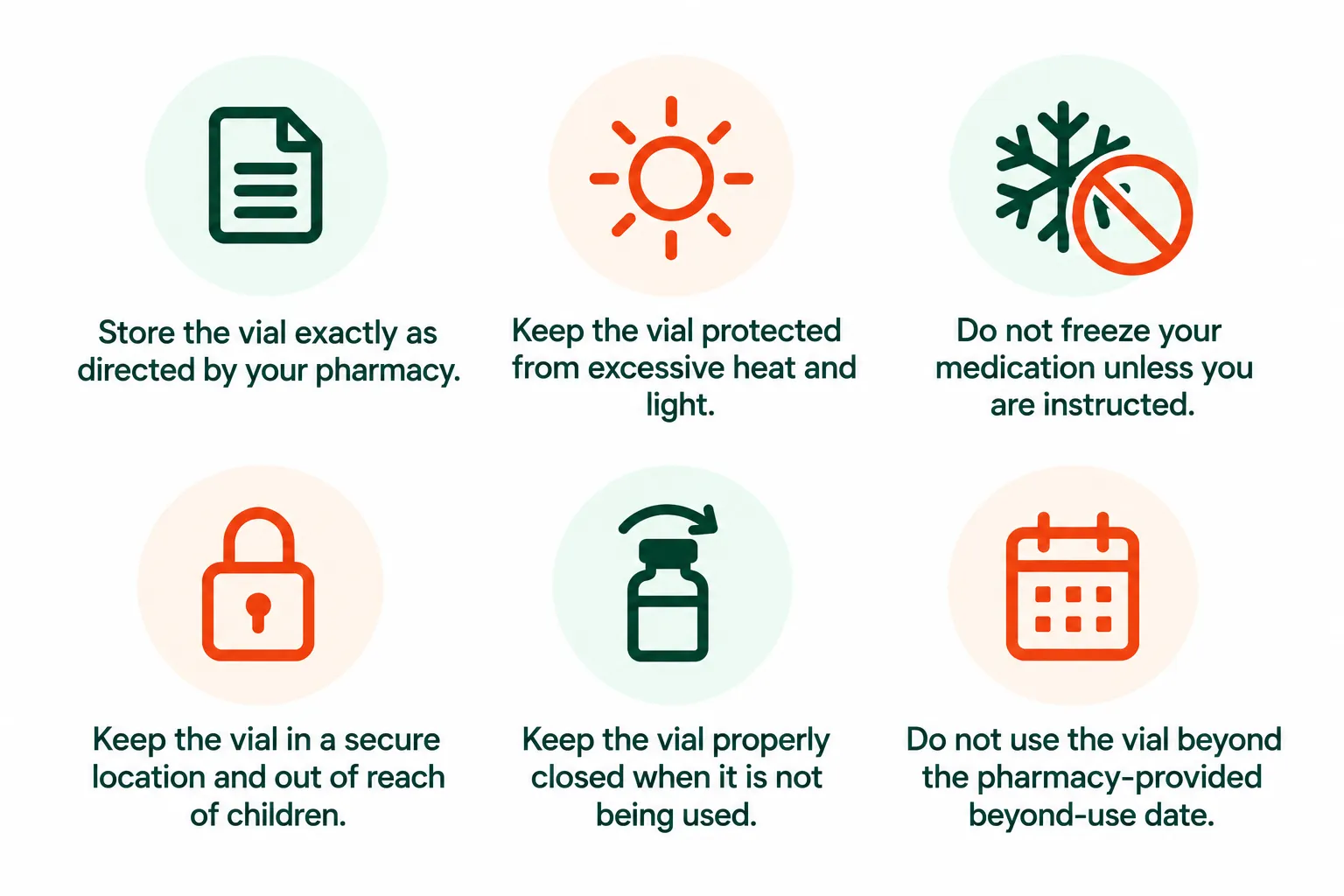
A multi-dose vial may have specific instructions regarding how long it can be used after the first puncture. Do not assume that the vial can be used until all of the liquid is gone.
Your pharmacy's instructions should determine:
Important: Vial size does not determine how long your medication remains usable. A larger vial does not automatically mean you should keep using it for a longer period. Follow the pharmacy's beyond-use date and handling instructions even if medication remains in the vial.
You may not necessarily need to keep increasing your dose. Your pharmacy's framework specifically recommends using variable-dose vials to achieve the lowest beneficial dose, even when that differs from the example schedule.
The purpose of titration is to find an effective and tolerable dose for the individual patient.
Some people experience gastrointestinal side effects when starting semaglutide or increasing the dose.
Possible side effects include:
Read more about semaglutide side effects.
If side effects become difficult to manage, do not increase your dose on your own.
Contact your prescribing provider. Your provider may decide to:
This can happen, particularly early in treatment.
The initial dose is intentionally low, and treatment response varies from person to person.
Do not respond by drawing additional medication from your vial.
Instead, talk to your healthcare provider.
Your provider can determine whether:
Never use extra syringe units simply because you feel the medication is not working yet.
You should not change your prescribed dose or accelerate titration without speaking with your healthcare provider.
Faster escalation can increase the risk of adverse effects.
Current obesity treatment guidance supports gradual titration and specifically allows for slower titration when tolerability is an issue.
Your treatment timeline may therefore look different from another person's.
That is okay.
Your medication plan should be individualized.
The supplied Semaglutide/Glycine/B12 framework uses:
One subcutaneous injection once weekly.
Try to follow the same weekly schedule prescribed by your provider.
For FDA-approved injectable semaglutide products, administration is also once weekly, although the exact dosing schedule depends on the specific product and indication.
This is another reason not to mix dosing instructions between products.
Subcutaneous semaglutide is injected beneath the skin.
FDA-approved injectable semaglutide products specify injection sites such as the:
Injection sites can be rotated.
For your compounded medication, follow the specific injection instructions provided with your prescription. See where semaglutide is injected.
If you have never injected medication from a vial before, ask your healthcare provider or pharmacy to demonstrate the process rather than trying to calculate or improvise the dose yourself.
Try to take your dose on the same day and at around the same time each week. If you miss a dose, do not automatically double your next dose.
Missed-dose instructions can differ between semaglutide products.
For example, the current Ozempic prescribing information instructs patients who miss a dose to administer it within 5 days; if more than 5 days have passed, the missed dose is skipped and the regular weekly schedule is resumed.
Because your compounded formulation is prescribed individually, follow the missed-dose instructions supplied with your medication or contact your prescribing provider/pharmacy if you are unsure.
Do not use an online dosing schedule for a different semaglutide product as a substitute for your prescription instructions.
This is different from simply being a few days late.
If you have missed multiple weekly injections, do not assume that you should immediately restart the same dose you were taking before.
Tell your provider how long it has been since your last injection.
Depending on the length of the interruption and your previous dose, your provider may decide that restarting at a lower dose or repeating part of the titration is more appropriate.
Do not restart a higher dose on your own after a prolonged break.
This is especially important with a multi-dose vial.
If you accidentally inject more semaglutide than prescribed, contact your healthcare provider or seek appropriate medical advice promptly.
Possible effects of excessive semaglutide exposure can include significant nausea, vomiting, abdominal pain, dehydration, and other adverse effects. The FDA has received reports of compounded semaglutide dosing errors involving substantially higher-than-intended doses, including cases requiring hospitalization.
Because semaglutide has a long half-life, symptoms may persist and medical observation may sometimes be necessary after an overdose.
If you experience severe or concerning symptoms, seek urgent medical care.
Imagine your prescription says: Inject 8 units weekly.
You might think:
“Eight units is always the same amount of semaglutide.”
It isn't.
The actual medication dose depends on the concentration of your vial.
For example, this article's formulation contains:
5 mg semaglutide per mL.
Another compounded formulation may have a different concentration.
That means the same syringe volume could deliver a different number of milligrams.
This is one of the reasons the FDA has specifically highlighted dosing errors involving compounded semaglutide. Patients get confused and some patients have accidentally administered several times the intended dose.
Use the dose, volume, and syringe-unit instructions that came with your specific prescription.
Do not copy a conversion from another vial.
This depends on both:
For this formulation, the available vial sizes may range from approximately 0.5 mL to 2 mL.
The total amount of semaglutide in the vial can therefore differ:
| Vial size | Total liquid | Semaglutide concentration | Total semaglutide in vial |
|---|---|---|---|
| 0.5 mL | 0.5 mL | 5 mg/mL | 2.5 mg |
| 1 mL | 1 mL | 5 mg/mL | 5 mg |
| 2 mL | 2 mL | 5 mg/mL | 10 mg |
This does not mean that you should use the entire vial within a particular number of weeks.
Your prescribed dose changes during titration, and the pharmacy determines the appropriate vial size, dispensing instructions, storage requirements, and beyond-use date.
Use the vial only according to the instructions provided with your prescription.
Your prescription may use different vial sizes at different stages.
For the sample framework:
This makes sense because your weekly injection volume increases as the dose increases.
The important point is that a larger vial does not mean a larger single dose.
It simply provides a greater total volume of medication.
Here is the easiest way to think about it:
Your vial is the container.
It might contain: 0.5 mL, 1 mL, or 2 mL.
Your formulation is the concentration.
For this product: 5 mg/mL semaglutide.
Your prescription is the dose.
For example: 0.20 mg once weekly.
Your syringe measurement is the volume.
For example: 4 units = 0.04 mL for the syringe instructions associated with this formulation.
Keeping these four concepts separate makes compounded semaglutide much easier to understand.
This distinction matters.
The dosing schedule for an FDA-approved semaglutide product is not automatically the dosing schedule for a compounded Semaglutide/Glycine/B12 formulation.
For example, the current U.S. Wegovy prescribing information starts at 0.25 mg once weekly and uses a different escalation schedule.
Your formulation's sample framework starts at:
0.20 mg once weekly
and progresses through:
0.40 mg → 0.90 mg → 1.50 mg → 2.20 mg.
Therefore:
Do not take a Wegovy dosing chart and use it to calculate the dose from your compounded vial.
The concentration, container, administration method, and prescription instructions can differ.
The FDA also notes that compounded semaglutide products can come in different concentrations and containers, which can increase the potential for dosing errors.
No.
This is an important misconception to address.
A higher dose may provide a stronger pharmacologic effect, but it may also increase the likelihood or severity of adverse effects.
Current ADA guidance specifically recommends individualizing the dose and titration approach based on:
The optimal treatment dose may therefore be less than the maximum approved dose.
Your pharmacy's framework similarly emphasizes using the lowest beneficial dose.
So the right question is not:
“How quickly can I reach the highest dose?”
It is:
“What dose gives me an appropriate response while I can tolerate it well?”
Your provider may look at several things rather than relying on the scale alone.
Appetite
Are you noticing less hunger?
Fullness
Are you becoming satisfied with smaller portions?
Cravings
Have cravings or persistent thoughts about food changed?
Weight-management response
Is your weight changing over time?
Side effects
Are nausea, constipation, reflux, vomiting, or other symptoms manageable?
Overall health
Are there other medical conditions or medications that need to be considered?
Current ADA guidance recommends assessing effectiveness and safety at least monthly during the first three months of obesity pharmacotherapy and at least quarterly afterward.
That means your semaglutide treatment should be an ongoing medical process, not simply a dosing chart.
Semaglutide can make it easier for some people to reduce food intake by changing hunger and fullness signals.
But it does not replace good nutrition.
As your appetite changes, the quality of the food you do eat becomes even more important.
Focus on nutrient-dense foods that provide:
Read more about nutrition while taking semaglutide.
Smaller meals may also be easier to tolerate, particularly during dose escalation.
The 2026 ADA Standards recommend dietary strategies such as reducing meal size, eating mindfully, and reducing high-fat or spicy foods when gastrointestinal symptoms occur.
Weight loss is not simply about seeing a lower number on the scale.
Body composition matters too.
When someone loses weight, some of the weight lost can come from lean tissue as well as fat tissue.
That is why resistance training, adequate protein intake, and an appropriate nutrition plan can be important parts of a comprehensive weight-management strategy.
Your formulation also contains glycine, but the presence of glycine should not be presented as proof that the formulation prevents muscle loss.
The primary pharmacologic weight-management action comes from semaglutide.
If preserving muscle mass is a priority for you, discuss protein intake, resistance exercise, and your overall nutrition plan with your healthcare provider or qualified nutrition professional.
Semaglutide is not recommended for weight loss during pregnancy. Weight loss offers no benefit during pregnancy and may pose risks to the developing fetus. Animal studies have identified potential reproductive risks, although the effects of semaglutide in human pregnancy are not fully established.
If You Are Pregnant or Planning to Become Pregnant
If you are pregnant: Do not use semaglutide for weight loss during pregnancy. If you become pregnant while taking semaglutide, discontinue the medication and contact your healthcare provider promptly.
If you are planning a pregnancy: Stop semaglutide at least 2 months before attempting to become pregnant, as recommended in the FDA-approved labeling for Wegovy, because the medication remains in the body for an extended period.
If you are breastfeeding: Consult your healthcare provider before using semaglutide. The safety of injectable semaglutide during breastfeeding has not been fully established.
What If You Become Pregnant While Taking Semaglutide?
Stop taking semaglutide and contact your healthcare provider promptly to discuss your medication exposure and next steps. Do not panic, but make sure your healthcare team knows when you last took the medication and the dose you received.
Because this guide covers a compounded semaglutide formulation, consult your prescribing provider for advice specific to your medication. Do not restart treatment during pregnancy unless your healthcare provider specifically advises you to do so based on your individual medical circumstances.
Semaglutide is not appropriate for everyone.
Before starting treatment, tell your healthcare provider about your medical history and all medications or supplements you take.
Your product information specifically warns against semaglutide use in people with a personal or family history of:
FDA-approved semaglutide labeling also includes important warnings and precautions concerning pancreatitis, diabetic retinopathy complications, gallbladder disease, kidney injury associated with dehydration, severe gastrointestinal adverse reactions, and hypoglycemia when used with certain glucose-lowering medications.
Semaglutide also slows gastric emptying, so tell your healthcare team that you take semaglutide before surgery or procedures involving anesthesia or deep sedation. Read the safety information
Your product instructions state that:
Semaglutide should not be used with another GLP-1 medication.
If you are currently taking another GLP-1 medication, tell your prescribing provider before starting semaglutide.
If you are switching medications, your provider can determine the appropriate transition plan.
Do not overlap medications simply because both are prescribed for weight management.
If you take insulin or certain other medications that lower blood glucose, your provider may need to consider your overall medication regimen when starting semaglutide.
The 2026 ADA Standards specifically note the importance of adjusting other glucose-lowering medications when appropriate to reduce the risk of hypoglycemia.
This is another reason why semaglutide dosing should be individualized rather than copied from someone else's treatment plan.
The starting dose depends on the prescribed formulation and treatment plan. For injectable semaglutide used for weight management, treatment typically begins at a low dose and increases gradually under medical supervision to help the body adjust.
For FDA-approved injectable semaglutide for weight management, the dose is generally increased at intervals of four weeks, as tolerated and prescribed. Your provider may adjust the schedule based on side effects and your response to treatment. Do not increase your dose on your own.
Do not change your dose based only on how you feel or how quickly you lose weight. Semaglutide dosing is individualized, and results may take time. Contact your prescribing provider before making any changes.
Syringe units depend on the medication concentration, prescribed dose, and syringe type. Units are not the same as milligrams, and the conversion can differ between vials. Follow the exact instructions provided by your prescriber or pharmacist. Never estimate your dose or rely on a dosing chart for a different formulation.
No. A multi-dose vial may contain several doses. Use only the amount prescribed for each injection, based on the vial concentration and your provider’s instructions. Do not inject the entire vial unless your prescription specifically directs that amount.
Instructions depend on the specific semaglutide product and how long it has been since your missed dose. Check your medication instructions or contact your pharmacist or prescribing provider. Do not take an extra dose to make up for a missed one.
Contact your healthcare provider or poison control promptly for advice, even if you feel well. Seek emergency medical care for severe or concerning symptoms, such as persistent vomiting, severe abdominal pain, fainting, or signs of dehydration.
No. Increasing the dose faster than prescribed can increase the risk of side effects. Follow your prescribed titration schedule and contact your provider if you have concerns about your progress.
Semaglutide is not recommended for weight loss during pregnancy. If you become pregnant while taking it, discontinue the medication and contact your healthcare provider promptly. If you are planning a pregnancy, stop semaglutide at least two months beforehand, as specified in the FDA-approved Wegovy prescribing information. Consult your provider before using semaglutide while breastfeeding.
Follow the storage instructions supplied with your specific medication. Protect the vial from excessive heat and light, and do not freeze it unless your pharmacy specifically instructs you otherwise. Keep it securely stored and out of reach of children and pets.
This guide is provided for general educational and informational purposes only. It is not intended to replace individualized medical advice, diagnosis, treatment, or instructions from a qualified healthcare professional.
Semaglutide is a prescription medication. Your healthcare provider is responsible for determining whether semaglutide is appropriate for you, selecting your dose, determining the timing and rate of dose adjustments, and providing instructions for administration, storage, missed doses, and discontinuation.
The dosing examples, dose-escalation schedule, injection volumes, syringe-unit conversions, vial sizes, and other medication information in this guide are specific to the compounded semaglutide formulation and concentration described in this document. They are provided for educational purposes and should not be applied to another semaglutide product, concentration, syringe, vial, or prescription. Compounded semaglutide products may differ in concentration, formulation, container, labeling, and instructions.
Do not calculate, change, increase, decrease, delay, or repeat your semaglutide dose based solely on this guide. Do not use a dosing chart found online as a substitute for the instructions provided with your prescription. Always verify the prescribed dose in milligrams (mg), the corresponding volume in milliliters (mL), and the syringe measurement with your prescribing healthcare professional or dispensing pharmacy before administering the medication.
Compounded medications are not FDA-approved and are not reviewed by the U.S. Food and Drug Administration (FDA) for safety, effectiveness, or quality before marketing. Compounded medications may carry additional risks, including differences in concentration and potential dosing errors. Patients using compounded semaglutide should follow the instructions supplied with their specific prescription and pharmacy-dispensed product.
Semaglutide can cause adverse effects and may not be appropriate for everyone. Important risks, contraindications, drug interactions, and precautions may apply. This guide does not contain all possible safety information. Before starting or changing treatment, discuss your medical history, current medications, allergies, pregnancy status or plans, and any other relevant health conditions with your healthcare provider.
If you experience severe or concerning symptoms, including persistent vomiting, severe abdominal pain, signs of dehydration, difficulty breathing, swelling of the face or throat, severe allergic symptoms, or other potentially serious reactions, seek prompt medical attention.
If you accidentally administer more semaglutide than prescribed, contact your healthcare provider or appropriate medical service promptly. Do not attempt to correct an accidental overdose by changing or skipping future doses without medical guidance.
The information in this guide is not a substitute for the prescribing information supplied with your medication. When there is any difference between this guide and your prescription label, pharmacy instructions, or healthcare provider's instructions, follow the instructions provided by your healthcare provider and dispensing pharmacy.
Medical information and prescribing recommendations can change as new evidence and regulatory guidance become available. Always use the most current medication labeling and clinical guidance applicable to your treatment.
American Diabetes Association Professional Practice Committee for Obesity. Pharmacologic treatment of obesity in adults: Standards of Care in Overweight and Obesity. Diabetes Obes Cardiometab Care. 2026;1(1):5-25. doi:10.2337/doci25-0008. Available from:
https://diabetesjournals.org/docm-care/article/1/1/5/164233/Pharmacologic-Treatment-of-Obesity-in-AdultsAmerican Diabetes Association Professional Practice Committee. 8. Obesity and weight management for the prevention and treatment of diabetes: Standards of Care in Diabetes—2026. Diabetes Care. 2026;49(Suppl 1). doi:10.2337/dc26-S008. Available from:
https://diabetesjournals.org/care/article/49/Supplement_1/S166/163915/8-Obesity-and-Weight-Management-for-the-PreventionUS Food and Drug Administration. FDA alerts health care providers, compounders and patients of dosing errors associated with compounded injectable semaglutide products [Internet]. Silver Spring (MD): US Food and Drug Administration; 2024 [cited 2026 Sep 28]. Available from:
https://www.fda.gov/drugs/human-drug-compounding/fda-alerts-health-care-providers-compounders-and-patients-dosing-errors-associated-compoundedUS Food and Drug Administration. Understanding the risks of compounded drugs [Internet]. Silver Spring (MD): US Food and Drug Administration; 2026 [cited 2026 Sep 28]. Available from:
https://www.fda.gov/drugs/human-drug-compounding/understanding-risks-compounded-drugsUS Food and Drug Administration. WEGOVY (semaglutide) injection, for subcutaneous use: prescribing information [Internet]. Silver Spring (MD): US Food and Drug Administration; 2025 [cited 2026 Sep 28]. Available from:
https://www.accessdata.fda.gov/drugsatfda_docs/label/2025/218316Orig1s000lbl.pdfUS Food and Drug Administration. OZEMPIC (semaglutide) injection: prescribing information [Internet]. Silver Spring (MD): US Food and Drug Administration; 2026 [cited 2026 Sep 28]. Available from:
https://www.accessdata.fda.gov/drugsatfda_docs/label/2026/209637s038lbl.pdfWilding JPH, Batterham RL, Calanna S, Davies M, Van Gaal LF, Lingvay I, et al; STEP 1 Study Group. Once-weekly semaglutide in adults with overweight or obesity. N Engl J Med. 2021;384(11):989-1002. doi:10.1056/NEJMoa2032183. Available from:
https://pubmed.ncbi.nlm.nih.gov/33567185/Bliddal H, Bays H, Czernichow S, et al. Once-weekly semaglutide in persons with obesity and knee osteoarthritis. N Engl J Med. 2024;391(17):1573-1583. doi:10.1056/NEJMoa2403664. Available from:
https://pubmed.ncbi.nlm.nih.gov/39476339/Blundell J, Finlayson G, Axelsen M, Flint A, Gibbons C, Kvist T, et al. Effects of once-weekly semaglutide on appetite, energy intake, control of eating, food preference and body weight in subjects with obesity. Diabetes Obes Metab. 2017;19(9):1242-1251. doi:10.1111/dom.12932. Available from:
https://pubmed.ncbi.nlm.nih.gov/28266779/Friedrichsen M, Breitschaft A, Tadayon S, Wizert A, Skovgaard D. The effect of semaglutide 2.4 mg once weekly on energy intake, appetite, control of eating, and gastric emptying in adults with obesity. Diabetes Obes Metab. 2021;23(3):754-762. doi:10.1111/dom.14280. Available from:
https://pubmed.ncbi.nlm.nih.gov/33269530/Kapitza C, Nosek L, Jensen L, Hartvig H, Jensen CB, Flint A. A randomized trial investigating the pharmacokinetics, pharmacodynamics, and safety of subcutaneous semaglutide once-weekly in healthy male Japanese and Caucasian subjects. Clin Pharmacol Drug Dev. 2019;8(2):164-176. doi:10.1002/cpdd.658. Available from:
https://pubmed.ncbi.nlm.nih.gov/29536338/US Food and Drug Administration. FDA's concerns with unapproved GLP-1 drugs used for weight loss [Internet]. Silver Spring (MD): US Food and Drug Administration; 2026 [cited 2026 Sep 28]. Available from:
https://www.fda.gov/drugs/postmarket-drug-safety-information-patients-and-providers/medications-containing-semaglutide-marketed-type-2-diabetes-or-weight-loss
Understand your tirzepatide dose in mg, mL, and syringe units. See the example titration chart, vial sizes, missed-dose guidance, and key safety tips.
Read More
Read mechanism of semaglutide for weight loss, the dosing schedule, clinical trial results, side effects, costs, and what happens when you stop treatment.
Read More
Nearly 49.1% of U.S. adults struggle to lose weight. Learn what GLP-1 medications are, who is eligible, and how they support sustainable weight loss.
Read More