
Semaglutide Dosing Guide: Vial Sizes, Weekly Doses, Titration & How to Measure Your Dose
Understand your semaglutide dose in mg, mL, and syringe units. See the example titration chart, vial sizes, missed-dose guidance, and key safety tips.
Read MoreA practical guide to compounded tirzepatide liposomal chewable tablet dosing, daily administration, dose titration, side effects, and important safety precautions.


Medically Reviewed by:
Dr. Jonathan C. Miller, MD | Dr. Benjamin Krasne, MD
This guide is for educational purposes only and applies only to the compounded Tirzepatide liposomal chewable tablet formulation described here. It does not replace advice from your healthcare provider. Always follow the dose and instructions provided with your prescription. Read the full medical disclaimer
Tirzepatide liposomal chewable tablets are a compounded oral formulation supplied as 3 mg scored tablets. The dosing instructions below apply only to this specific formulation and should not be used as a dosing guide for FDA-approved injectable tirzepatide products.
The liposomal delivery approach described for this formulation is based on general drug-delivery literature. Its absorption, effectiveness, and clinical benefits have not been independently established in clinical studies of this specific compounded product.
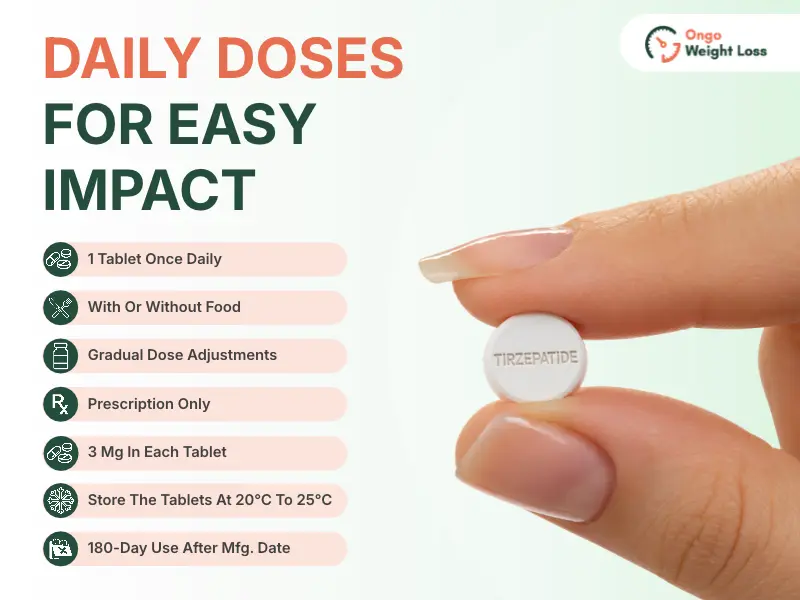
Important: Do not increase your dose or take additional tablets without instructions from your healthcare provider.
Each scored tablet contains 3 mg of tirzepatide.
| Treatment Period | Daily Dose |
|---|---|
| Weeks 1–4 | 1 tablet (3 mg) |
| After 4 weeks | May increase by ½ tablet as directed |
| Maximum in this formulation | 2 tablets (6 mg) |
The goal of titration is to identify a dose that is appropriate and tolerated for you. Not every patient will require the maximum dose.
Follow the missed-dose instructions provided by your healthcare provider or dispensing pharmacy. Do not double your next dose or take extra tablets unless specifically instructed.
Individual responses can vary. Do not take additional tablets because you feel the medication is not working. Talk with your healthcare provider before changing your dose.
Common gastrointestinal side effects may include:
If symptoms are severe, persistent, or worsening, contact your healthcare provider. Persistent vomiting or diarrhea can lead to dehydration.
Thyroid C-cell tumors: Do not use tirzepatide if you or a family member has medullary thyroid carcinoma (MTC) or if you have Multiple Endocrine Neoplasia syndrome type 2 (MEN 2). Tirzepatide has caused thyroid C-cell tumors in rodents, but it is unknown whether this occurs in humans.
Serious allergic reactions: Tell your healthcare provider if you have previously experienced a serious allergic reaction to tirzepatide or any ingredient in your medication. Seek immediate medical attention for symptoms of a serious allergic reaction, such as swelling of the face or throat or difficulty breathing.
Pancreatitis: Contact your healthcare provider promptly if you develop severe or persistent abdominal pain, particularly if it radiates to your back and may occur with nausea or vomiting.
Gallbladder problems: Contact your healthcare provider if you develop symptoms that may indicate gallbladder disease, including persistent abdominal pain, particularly with nausea or vomiting.
Gastrointestinal effects: Tirzepatide can cause gastrointestinal adverse reactions, which may sometimes be severe. It is not recommended for people with severe gastroparesis.
Dehydration and kidney problems: Vomiting or diarrhea can cause fluid loss and may affect kidney function. Maintain adequate fluid intake and contact your provider if these symptoms are persistent.
Low blood sugar: The risk of hypoglycemia may increase when tirzepatide is used with insulin or certain medications that stimulate insulin release. Tell your provider about all diabetes medications you take.
Diabetic retinopathy: If you have diabetes and a history of diabetic retinopathy, tell your healthcare provider and report new or worsening vision changes.
Surgery or sedation: Tirzepatide delays gastric emptying. Tell your healthcare team that you take tirzepatide before any planned surgery or procedure requiring general anesthesia or deep sedation.
Do not combine tirzepatide with another GLP-1 receptor agonist or another tirzepatide-containing medication unless specifically directed by your healthcare provider.
Tell your healthcare provider if you are pregnant, planning to become pregnant, or breastfeeding.
For FDA-approved tirzepatide, pregnancy is a reason to discontinue treatment because of potential fetal harm. The safety of this compounded liposomal chewable formulation during pregnancy and breastfeeding has not been established.
Tirzepatide can delay gastric emptying and may affect the absorption of oral medications. If you use an oral hormonal contraceptive, discuss contraceptive options with your healthcare provider, particularly when starting treatment or after a dose increase. The FDA-approved tirzepatide label recommends a non-oral contraceptive method or an additional barrier method for 4 weeks after initiation and for 4 weeks after each dose escalation.
Store the tablets at 68°F to 77°F (20°C to 25°C) unless your dispensing pharmacy provides different instructions.
Do not use the medication after the pharmacy-provided 180-day beyond-use date.
This product is a compounded medication and is not FDA-approved. Compounded medications are not reviewed by the FDA for safety, effectiveness, or quality before marketing. They should be used only when appropriate for an individual patient's medical needs and under the direction of a licensed healthcare professional.
The dosing information on this page applies only to the specific 3 mg Tirzepatide Liposomal Chewable Tablet formulation described here. The potential benefits of tirzepatide described in general medical literature should not be interpreted as evidence that this specific compounded oral formulation has been clinically proven to provide the same effects.
Always follow the prescription and instructions provided by your healthcare provider and dispensing pharmacy. Do not change your dose, stop treatment, or combine medications without consulting your provider.

Explore our latest articles, guides, and health insights.
Understand your semaglutide dose in mg, mL, and syringe units. See the example titration chart, vial sizes, missed-dose guidance, and key safety tips.
Read More
Understand your tirzepatide dose in mg, mL, and syringe units. See the example titration chart, vial sizes, missed-dose guidance, and key safety tips.
Read More
Read mechanism of semaglutide for weight loss, the dosing schedule, clinical trial results, side effects, costs, and what happens when you stop treatment.
Read More
Nearly 49.1% of U.S. adults struggle to lose weight. Learn what GLP-1 medications are, who is eligible, and how they support sustainable weight loss.
Read More